South Downs Planetarium complies with all the regulations and guidelines regarding 'Learning Outside the Classroom' and the New Government Guidance on Health and Safety on educational visits.

We are pleased to state that we have received many visitors from organisations that specifically cater for young people and adults who have additional educational and learning requirements.
In these circumstances we strongly advise that a private booking is made so that we can tailor the content of the entire show to accommodate your needs. In these circumstances our volunteers can focus on and meet your needs as a group so that everyone gets the most out of the visit to the Planetarium. There are many occasions when patrons with additional needs join our public shows. We appreciate that the individual or their carer will know whether a period of time in the dark, moving pictures and the ability to be able to listen to the presenter for an hour is a realistic expectation. We leave this to your judgement, but please feel free to discuss your requirements with us if you have any queries.
Please do try to book your visit early and note that the Planetarium is particularly busy between September and April. We look forward to meeting you and your school group during the coming academic year.
The easiest way to book your Planetarium visit is to email the Planetarium with a brief summary of your requirements. This should include the name of your school or college, number of students attending, age or year group and when you would ideally like to visit, mentioning any days or dates that you would prefer or ones you definitely cannot do. This is the best way to contact us, but first please read the notes below and PLEASE do provide us with a contact telephone number and the best time to call.
sdownsplanet@proton.me The Planetarium’s telephone number (weekdays, 10am to 4pm) is 01243 774400
As of January 2026, the cost of a typical Planetarium visit is £6.00 per child, teachers and adult helpers free of charge, but West Sussex LEA schools enjoy a discount of 50p per child on the normal admission price. There is a minimum hire charge of £200 per school group, reduced to £180 for West Sussex LEA schools. This means that if you bring 33 pupils or fewer (32 or fewer for West Sussex schools) then the minimum hire charge applies.
Specialist presentations, including those for GCSE or A-level students and university undergraduates may incur a slightly higher per capita charge.
We recognise that school visits must always be cost effective, especially so in the current economic climate, and need careful planning to achieve this.
It may be that it is cheaper to use minibuses or parents' cars rather than to hire a large coach. Also, schools should consider the use of public transport, if possible. The Planetarium is only a short walk from rail and bus stations and many schools have found that bringing a group by train or bus can yield very considerable savings over the cost of hiring a coach, for example.

The South Downs Planetarium and Science centre was established to provide a facility where people of all ages can learn about science in a very visual and exciting way.
demonstrations
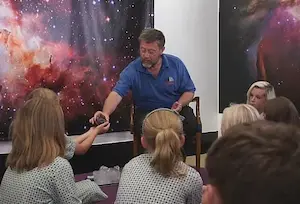
There's something very special about giving a child a piece of meteorite, which was a space rock, and to tell them that this is probably going to be the oldest rock or object they will ever hold in their hands" Graham Bryant
We provide a wide range of presentations for schoolchildren which both complements and supplements their National Curriculum work and meets the basic educational needs of a range of ages and abilities.
These Presentations supplement school studies for:
- National Curriculum Key Stages 1, 2, 3 and 4,
- GCSE Astronomy,
- General Studies, including Environmental Science, and Physics at GCSE, AS and A2 level.
Since opening in July 2001, the Planetarium has hosted visits by around 10,000 children of school age every year.Through its colourful displays, demonstrations and presentations in the main auditorium, young people are introduced to the awe and wonder of the universe around us and are inspired to want to learn more.
The Planetarium is an educational charity managed and operated by a large team of volunteers and enthusiasts, who have a passion for science and education and believe that learning should be fun! This enthusiasm is clearly infectious because many of our school groups and individual visitors come back to us time and time again.
Routine visits These involve no more than an everyday level of risk, such as for slips
and trips, and are covered by a school’s current policies and procedures. They only need
a little extra planning beyond the educational aspect of the trip and can be considered
as a lesson in a different classroom. Health and safety on educational visits

Presentations can also be made to suit specific requirements. For example, for older students, topics such as life on other planets, the birth, life and death of stars, galaxies, the Big Bang and the expanding universe may be covered. Each presentation, given by an experienced lecturer, is of about 50 minutes' duration, followed by a question and answer session.
The Science centre.
The Science centre provides a highly adaptable multi-purpose space for use by visiting school groups and as a location for additional exhibits and hands-on activities during courses for adults and children.
A centre for associated sciences
Its role is in exploring and educating not just Astronomy and Astrophysics but also other 'Earth Sciences' such as Geophysics Geomorphology and Meteorology.
Library
An extensive Astronomical Library. A Laboratory/Workshop and an Information Technology centre.
The ‘Richard Bunker Lecture and Video Theatre’ and ‘Science centre’
The hall provides seating for over 60 people. As well as providing a secure and comfortable location for visitors to leave coats and bags and to eat lunch. It also include: Viewspace an internet-connected computer and large-format HD TV display to show the latest images, movies, animations and news from the Hubble Space Telescope, NASA spacecraft observatories.
Note for Satnav users.
Satnav postcode use PO19 8EB
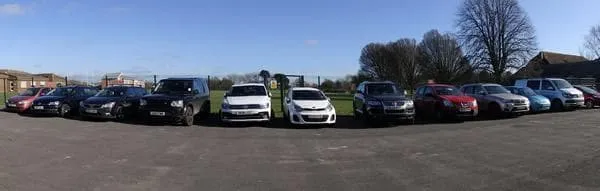
The South Downs Planetarium one of two car parks.
The effective teaching of astronomy involves viewing the night sky, but to take students "star-gazing" is often impractical.
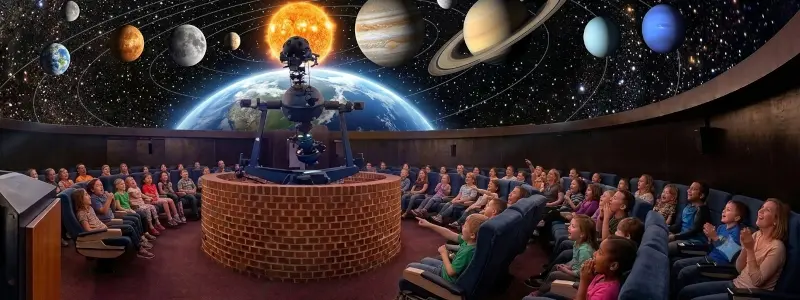
Fully experience the dynamics of the heavens sitting inside our 11-metre dome. This makes clear many of the basic aspects of astronomy and space science in an exciting and easy to learn way.
We provide the excitement and wonder of a 'Big Sky Dome' to about 10,000 children per year.
The Solar Trail
Our "Solar Trail ", runs along the 200 yards of approach road leading from the school roundabout in front of the Sixth Form centre down to the Planetarium.
The Solar Trail provides much needed lighting along the approach road utilising 'full cut-off design' ensuring that there is minimal light pollution.
Displayed on the lamp-posts at regular intervals are interesting facts about each of the planets in the Solar System.
From the new Sports centre, (named after Major Tim Peake, British astronaut), the trail starts with the dwarf planet Pluto and then in sequence points representing Neptune, Uranus, Saturn, Jupiter, Mars, Earth, Venus, Mercury and, finally, the Sun.
The Solar Trail has been made possible through the generosity of the following
- Seagull Trust,
- Urbis Lighting Ltd,
- Brian Fieldhouse,
- Henry Adams and Partners, with technical advice and assistance from Gerry Davis.
Normally you will have the Planetarium to yourself – always if you have paid for exclusive use. For the smaller school groups, if you do not require exclusive use, it may be feasible to combine with another group to reduce the cost per group, but we will always try to match age and ability. Do contact the Planetarium if you would like to explore this option further.
Lunches
Schools coming from some distance can bring a snack or packed lunch to eat during their visit, but please arrange and agree this with the Planetarium in advance.
In addition, if your school is near to a bus route or railway station did you know that operators are willing and often able to make special arrangements to meet your needs? This might include running an additional vehicle on a scheduled bus route at a time agreed by prior arrangement. Such options may well be cheaper than coach hire.
The following are the relevant contact details for the companies who will be pleased to discuss your specific requirements for group bookings on scheduled services. Please be sure to allow at least one month's notice ahead of your travel date.
- Bus - Stagecoach: 0845 1210190
- Train - Southern Rail: 0845 1272920
Elson Junior School Gosport
The children absolutely loved their visit. It is related to our work this half term and
has set the children up for 'Tim Peake' next half term. Thank you.
West Chiltington Primary School
Spot on - really liked the ISS footage in the Planetarium. The children really enjoyed
it. Thank you for the teas and coffees too!
Morelands Primary School
Content pitched really well for year 5 group. Really good to include content from recent
events. There is a lot of information to take in. Children definitely benefit from
learning things before visiting to help them take everything in
Walberton and Binsted CofE Primary School
A great presentations as always. Really fascinating and relevant to our topic. It is
great the way the presentation changes a little year-on-year. It is great to include
information on Tim Peake and the ISS. It is also very good to have a Q and A afterwards
West Park Primary School
The children enjoyed having the opportunity to ask questions. Very friendly organised
staff to help. A credit to the Planetarium
Broadwater CofE Primary School
A very enjoyable talk relevant to us:- Nice to see you change it with up-to-date
information too.
These presentations meet the specific needs of university undergraduates, individual colleges and schools, including those from overseas as well as various adult and youth groups.
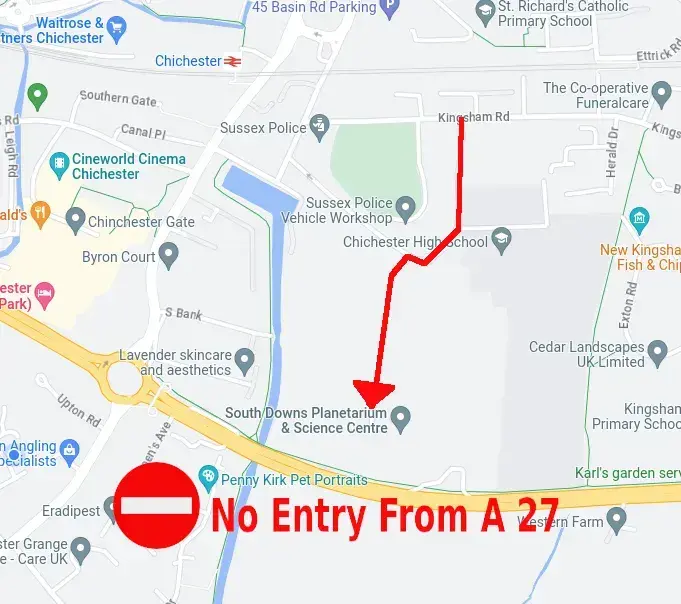
Important DO NOT rely on Google Maps
There is no direct access off the Chichester Bypass. All access via
Kingsham Road only.
SEE MAP BELOW.
Satnav postcode use PO19 8EB
What Three Words App Data
The only entrance for walkers, cars buses, lorries, coaches, PoGo sticks or Space Hoppers, is by the High School entrance in Kingsham Road, then follow the signs to "The South Downs Planetarium and Science centre" It is located at the southern end of the Chichester High Schools campus.